Excess subterranean humidity in Franklin County residential structures creates an ideal habitat for destructive structural pests. According to moisture guidelines documented by the U.S. Department of Energy ,…
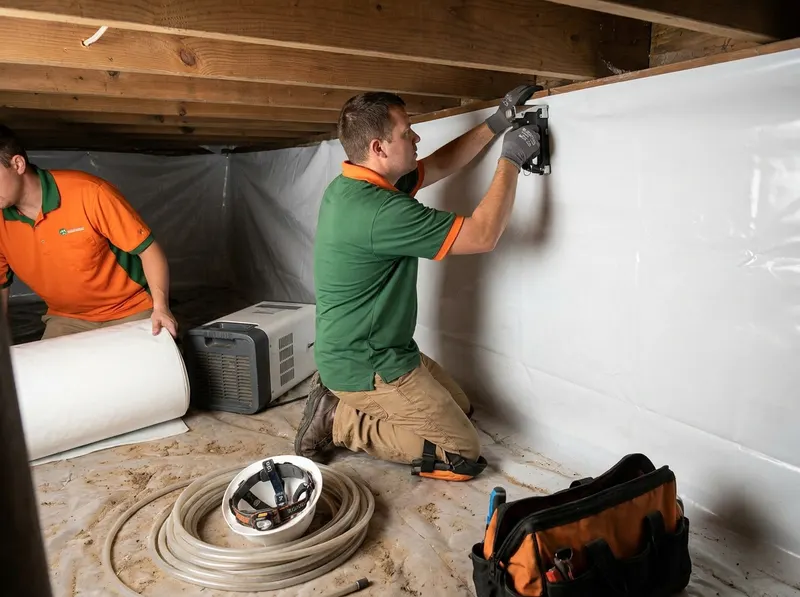
Excess subterranean humidity in Franklin County residential structures creates an ideal habitat for destructive structural pests. According to moisture guidelines documented by the U.S. Department of Energy, unconditioned, vented foundation voids draw outdoor relative humidity into lower framing members via the stack effect. In older neighborhoods like Clintonville, Victorian Village, and German Village, continuous ground dampness elevates joist moisture content above 20%. This critical threshold supports infestations of wood-decay fungi, subterranean termites, and moisture-reliant organisms such as silverfish and camel crickets. By isolating damp foundation soil from interior air currents, encapsulation eliminates the moisture vector these organisms require to colonize the floor subdeck.
Subterranean moisture control adheres to standards defined by the U.S. Environmental Protection Agency for indoor environmental quality and structural drying. In communities such as Upper Arlington, Bexley, and Grandview Heights, river-adjacent alluvial geology along the Olentangy and Scioto corridors creates chronic hydrostatic pressure against century-old block and rubble walls. Unchecked ground evaporation rots floor joists, damages wiring wrapped in damp crawl bays, and allows wood-boring insects to migrate directly into baseboards and living rooms without visible exterior shelter tubes. Sealing foundation perimeter vents compliant with section R408.3 of the International Residential Code stops warm summer humidity from condensing against cool subterranean floor infrastructure.
Remediation protocols require an orderly mechanical progression to ensure subfloor longevity and biological exclusion:
Choosing full crawlspace encapsulation over superficial poly-sheeting involves balancing budget against structural protection. While unfastened 6-mil plastic loosely draped on dirt offers a minor short-term reduction in soil vapor, it leaves foundation walls exposed, punctures under foot traffic, and allows subterranean wood beetles and rodents to tunnel unobstructed. True encapsulation seals foundation walls, closes external vents, and mechanically conditions crawlspace air, eliminating the conditions that support structural wood-boring beetles described by the U.S. Forest Service. Homes located near wetlands or low-lying drainage zones in Franklinton, Worthington, and Olde Towne East gain permanent pest resistance, lowered heating load, and cleaner indoor air throughout the floor system.
Every job gets a firm, written price after an on-site visit.
Tell us about your crawlspace encapsulation & moisture remediation job in Columbus and we'll send a clear, written quote, usually the same day.
 SummitBloom Pest Protection